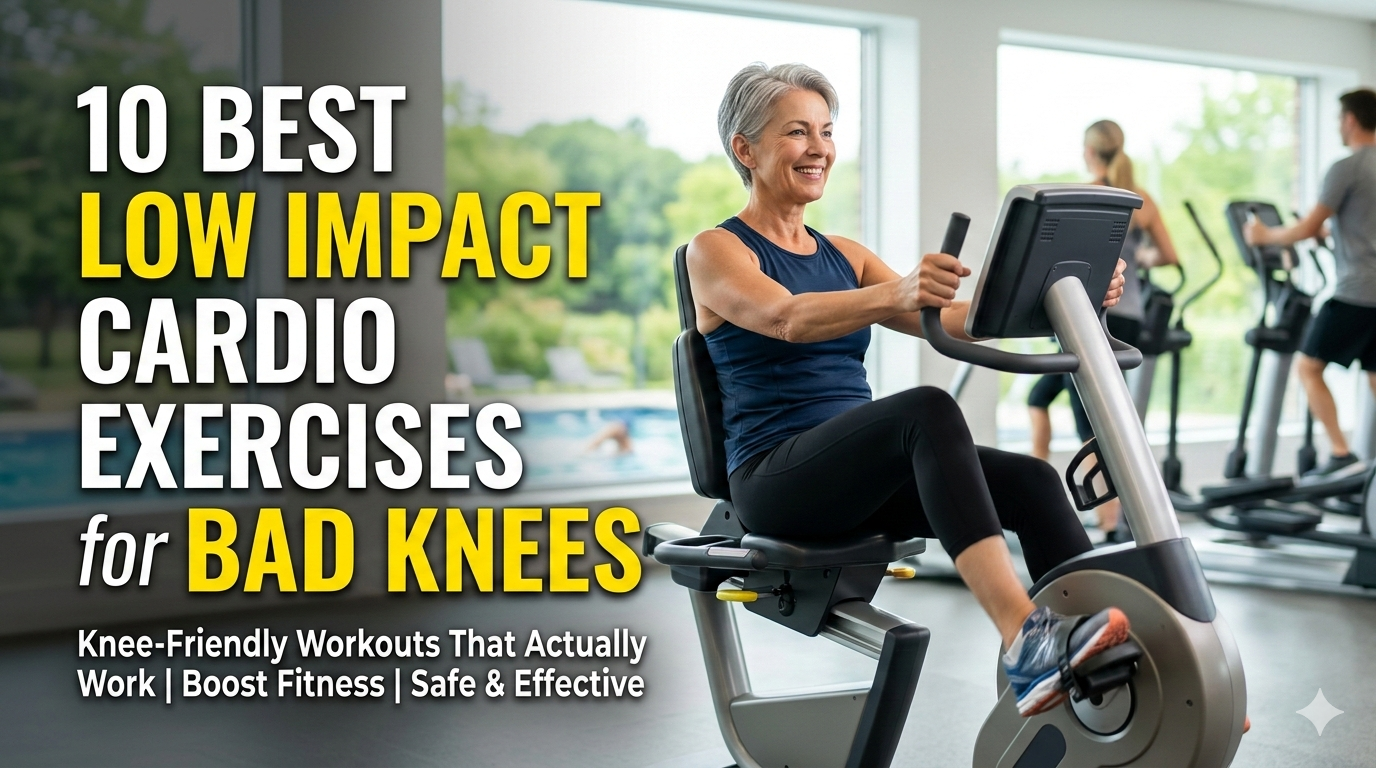
If knee pain has been keeping you off the treadmill — you are not alone. Millions of people deal with knee pain caused by osteoarthritis, runner’s knee, bursitis, or old injuries, and most cardio advice completely ignores them.
The good news? You do not have to choose between protecting your knees and staying fit. Low impact cardio for bad knees is not just possible — it is one of the smartest things you can do for long-term joint health, weight management, and cardiovascular fitness.
In this guide, you will find 10 of the best low impact cardio exercises for people with bad knees, why they work, how to do them safely, and what to avoid. Whether you have knee osteoarthritis, chronic knee pain, or are recovering from knee surgery, there is something here for you.
| 📌 What You Will Learn in This Article ✅ Why low impact cardio is better than rest for knee pain ✅ 10 best low impact exercises for bad knees (with instructions) ✅ Exercises to avoid if you have knee problems ✅ Tips from physios on exercising safely with knee pain ✅ How long until you see results |
Why Low Impact Cardio Is the Right Choice for Bad Knees
Before we dive in, let us address something important: the idea that you should rest when you have knee pain is largely outdated advice.
Research shows that gentle, low impact movement actually helps reduce knee pain over time. Here is why:
- Movement lubricates joints by encouraging synovial fluid production — the natural oil inside your knee joint.
- Strengthening the muscles around the knee (quadriceps and hamstrings) reduces stress on the joint itself.
- Low impact cardio supports weight loss — every extra pound adds roughly 4 pounds of pressure on the knee joint.
- Improved circulation from aerobic exercise helps reduce chronic inflammation around the knee.
The key difference between high impact vs low impact exercise is ground reaction force. High impact activities like running and HIIT send jolts through your joint. Low impact exercise keeps one foot on the ground at all times — dramatically reducing shock load.
10 Best Low Impact Cardio Exercises for Bad Knees
These exercises are ranked from gentlest to slightly more demanding — start from the top if you are in significant pain.
1. Swimming and Water Aerobics
Best for: Severe knee pain, post-surgery recovery, osteoarthritis
Swimming is arguably the best cardio exercise you can do with bad knees. The buoyancy of water supports up to 90% of your body weight, meaning your knees experience almost zero impact stress while you still get a full-body cardiovascular workout.
Water aerobics and aqua jogging are equally effective. The resistance of water also provides light muscle strengthening — particularly for the muscles that support the knee — without loading the cartilage.
| How to Get Started Start with 20-30 minutes of gentle lap swimming or a group aqua aerobics class. Use a pool noodle for aqua jogging if recovering from surgery. Aim for 3 sessions per week. Most people notice reduced joint stiffness within 2-3 weeks. |
2. Cycling (Stationary Bike or Outdoor)
Best for: Knee arthritis, runner’s knee, general knee pain
Cycling is one of the most recommended low impact cardio workouts for knee pain by physiotherapists worldwide. The circular pedaling motion moves the knee through its natural range of motion without loading it.
A stationary bike is ideal because you control resistance and can stop if pain increases. Recumbent bikes (reclined position) are even gentler on the knees and lower back.
Key tip: Set your seat height so your knee is slightly bent (25-30 degrees) at the bottom of the pedal stroke. Too low forces deep knee flexion, which increases patellofemoral pain.
3. Walking — The Underrated Powerhouse
Best for: Mild to moderate knee pain, beginners, everyday fitness
Do not underestimate walking. A brisk 30-minute walk burns calories, strengthens the leg muscles that support your knees, and improves cardiovascular health — all with very low joint stress.
Walk on grass or rubberized tracks rather than concrete when possible. Invest in supportive walking shoes with good cushioning. Consider a knee compression sleeve if you experience swelling after walks.
- Start with flat ground and gradually introduce gentle inclines.
- Avoid long downhill walks — descending places more stress on the knee joint than going uphill.
- Nordic walking with poles reduces knee load by up to 25% while engaging the upper body.
4. Elliptical Trainer
Best for: People who miss running, moderate knee pain
The elliptical simulates running but without your feet ever leaving the pedals — eliminating the impact phase entirely. Studies show the elliptical produces 20-70% less knee joint loading compared to treadmill running at the same effort level.
Pro tip: Keep a slight forward lean and push through your heels, not your toes. This shifts the workload toward your glutes and hamstrings, further protecting the knee.
5. Seated Cardio Exercises
Best for: Severe knee pain, limited mobility, chair-bound individuals
Seated cardio is often overlooked but incredibly effective for people who struggle to stand due to knee, hip, or back pain.
- Seated marching: Lift alternate knees as fast as you comfortably can for 1-2 minute intervals.
- Seated boxing: Punch forward and to the sides with energy — gets your heart rate up quickly.
- Seated jumping jacks: Arms and legs move simultaneously while seated.
Search ‘chair cardio for knee pain’ on YouTube — you can get a genuine cardiovascular workout without leaving your chair.
6. Rowing Machine
Best for: Full-body workout with minimal knee bend required
Rowing engages 86% of your muscles simultaneously and is a surprisingly knee-friendly cardio exercise. The knee bends during the recovery phase at a controlled, low-load angle with no impact.
Drive through the heels, use the legs as primary power generators, and keep the movement smooth. Avoid rowing if you have acute knee inflammation or have been told to avoid knee flexion beyond 90 degrees.
7. Yoga and Tai Chi
Best for: Chronic knee pain, stress-related inflammation, flexibility
Both yoga for knee pain and Tai Chi are evidence-backed approaches for osteoarthritis. Multiple studies found Tai Chi reduces knee pain and improves function just as effectively as standard physical therapy.
The slow, flowing movements build strength in stabilizing muscles, improve proprioception, and reduce fear-avoidance patterns that can worsen chronic pain. Look for ‘yoga for bad knees’ or ‘Tai Chi for arthritis’ classes — specifically modified to avoid deep knee bends.
8. Resistance Band Cardio
Best for: Home workouts, building knee-supporting muscles
Light resistance bands can transform simple leg movements into effective cardiovascular exercise while simultaneously strengthening the muscles that protect your knees.
- Side-lying leg raises with band: Works hip abductors critical for knee stability.
- Seated leg extensions with band: Gently activates quadriceps without standing load.
- Standing clamshells with band: Strengthens glutes, reducing knee valgus stress.
9. Low Impact Dance and Aerobics (Modified)
Best for: People who enjoy group fitness, those wanting variety
Low impact aerobics keeps at least one foot on the floor at all times — removing the jumping that makes traditional aerobics problematic for people with knee problems.
Search ‘low impact cardio no jumping’ on YouTube for genuinely joint-friendly options. The motivational benefits of dance-based workouts also improve exercise adherence significantly.
10. Hiking on Flat Terrain
Best for: Mild knee pain, people who prefer outdoor exercise
Flat trail hiking combines walking benefits with natural terrain variation that improves ankle and knee proprioception over time. The uneven ground gently challenges stabilizing muscles without the repetitive pounding of road surfaces.
Use trekking poles — they reduce the compressive force on each knee by 12-25% per step. Avoid steep descents, which place 3-4x body weight on the knee joint.
Exercises to Avoid with Bad Knees
Just as important as knowing what to do is knowing what to skip:
| Exercise to Avoid | Why It Is Problematic |
| Running on hard surfaces | High impact — 3x body weight per step |
| Deep squats | Maximizes compressive patellofemoral force |
| Jumping jacks / burpees | Landing impact spikes knee joint load acutely |
| High-impact HIIT | Repeated jumping and fast direction changes |
| Leg press (low seat) | Deep knee flexion under load — injury risk |
| Stair descents with pain | 3-4x body weight on joint per step |
Expert Tips for Exercising Safely with Knee Pain
1. Warm up every single time. Cold joints are more vulnerable. Spend 5 minutes on gentle range-of-motion movements before any cardio.
2. Follow the 10% rule. Never increase exercise duration or intensity by more than 10% per week — give joint tissues time to adapt.
3. Ice after if needed. If your knee is warm or swollen after a workout, 15-20 minutes of ice (wrapped in cloth) can reduce inflammation.
4. Strengthen your quads. Quadriceps strengthening is the single most evidence-backed intervention for knee osteoarthritis pain.
5. Use the 0-10 pain scale. Exercise at 3/10 pain or below is generally safe. If pain rises above 5/10 during or after exercise, stop and rest.
6. Consider compression sleeves. They provide proprioceptive feedback and warmth that many people with chronic knee pain find helpful during exercise.
| How Long Until You See Results? Most people notice reduced stiffness and improved mood within 1-2 weeks of consistent low impact exercise. Pain reduction: 3-6 weeks of consistent exercise (3-4x per week) Improved strength and joint stability: 6-12 weeks Measurable cardiovascular fitness improvements: 8-10 weeks |
Frequently Asked Questions
Is it OK to do cardio with bad knees?
Yes — in most cases, low impact cardio is not only safe but actively beneficial. Movement lubricates the joint, reduces inflammation over time, and strengthens the surrounding muscles that act as natural shock absorbers. Choose the right type of exercise and build up gradually.
What is the best cardio machine for bad knees?
The stationary bike (especially recumbent bikes) and elliptical trainer are the top recommendations from physiotherapists for people with knee problems. Both provide effective cardiovascular exercise with minimal joint stress. The rowing machine is excellent when there is no acute inflammation.
Is walking good for bad knees?
Walking is generally beneficial when done on flat, cushioned surfaces with supportive footwear. It maintains joint mobility, strengthens leg muscles, and supports weight management. Start with shorter, flat walks and build duration gradually.
Can I do HIIT with bad knees?
Traditional HIIT involves jumping and rapid direction changes — problematic for bad knees. However, low impact HIIT applies interval training principles to joint-friendly exercises like cycling sprints, rowing intervals, or seated cardio bursts. You get the metabolic benefits without the joint stress.
How often should I exercise with bad knees?
Most guidelines suggest 3-5 sessions of low impact cardio per week, with rest days in between for joint recovery. Start with 3 sessions of 20-30 minutes and build from there as your pain levels and fitness improve.
Final Thoughts
Living with knee pain does not mean giving up on fitness. With the right low impact cardio exercises — swimming, cycling, walking, elliptical training, and more — you can build genuine cardiovascular health, manage your weight, and even reduce your knee pain over time.
The most important thing is to start. Even 15 minutes of gentle movement three times a week is infinitely better than waiting for the pain to disappear on its own.
If your knee pain is severe, unexplained, or has come on suddenly, always consult a doctor or physiotherapist before starting a new program. Your knees have carried you a long way. With the right approach, they can carry you much further.