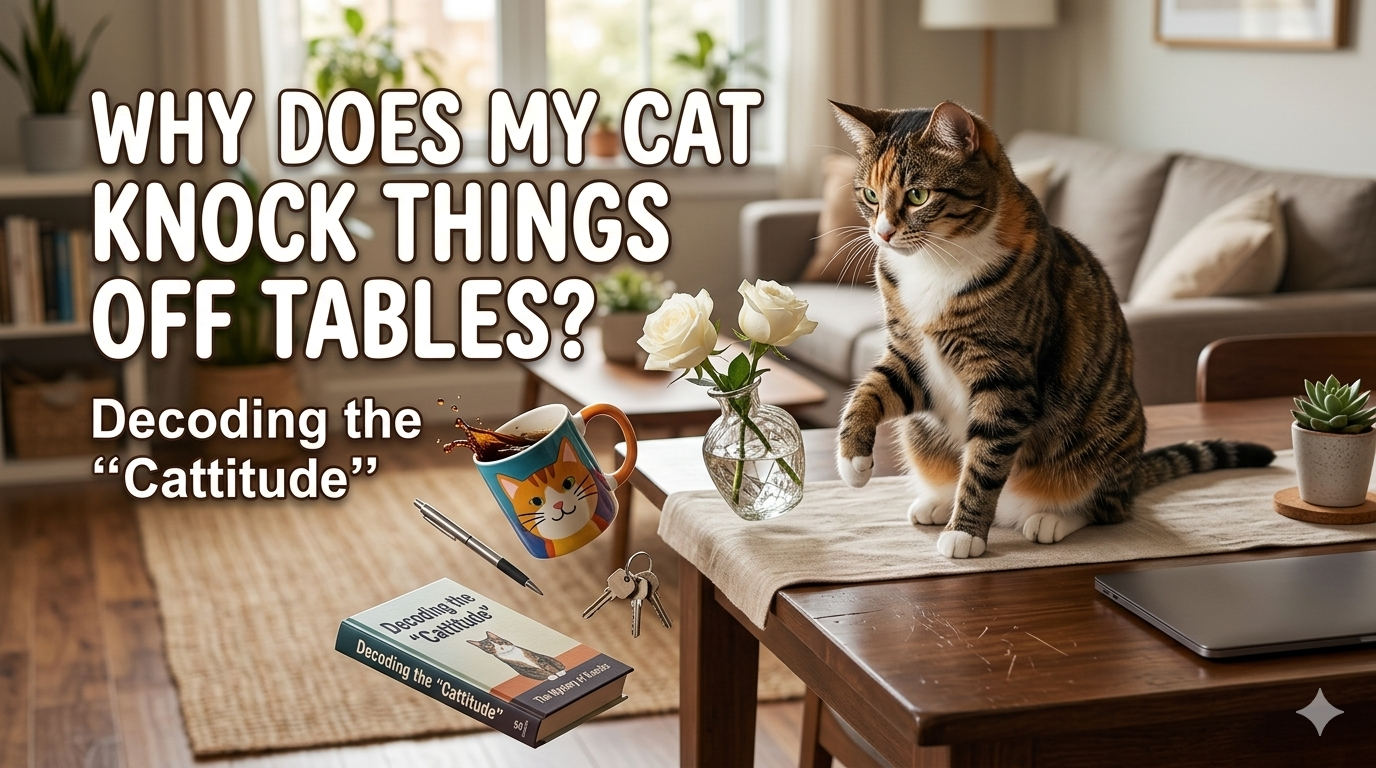
If you own a cat, you’ve likely experienced the “slow-motion stare-down.” Your cat looks you dead in the eye, raises a delicate paw, and deliberately, agonizingly, taps your favorite mug until it shatters on the floor.
It feels deeply personal, as if your feline companion is deliberately trying to annoy you. But in the world of feline behavior, it’s rarely about malice. This maddening habit is a mix of ancient biology, learned manipulation, and a simple need for entertainment.
By understanding why cats knock things over, you can save your glassware and improve your bond with your mischievous pet.
1. The Hunting Instinct (Object Play)
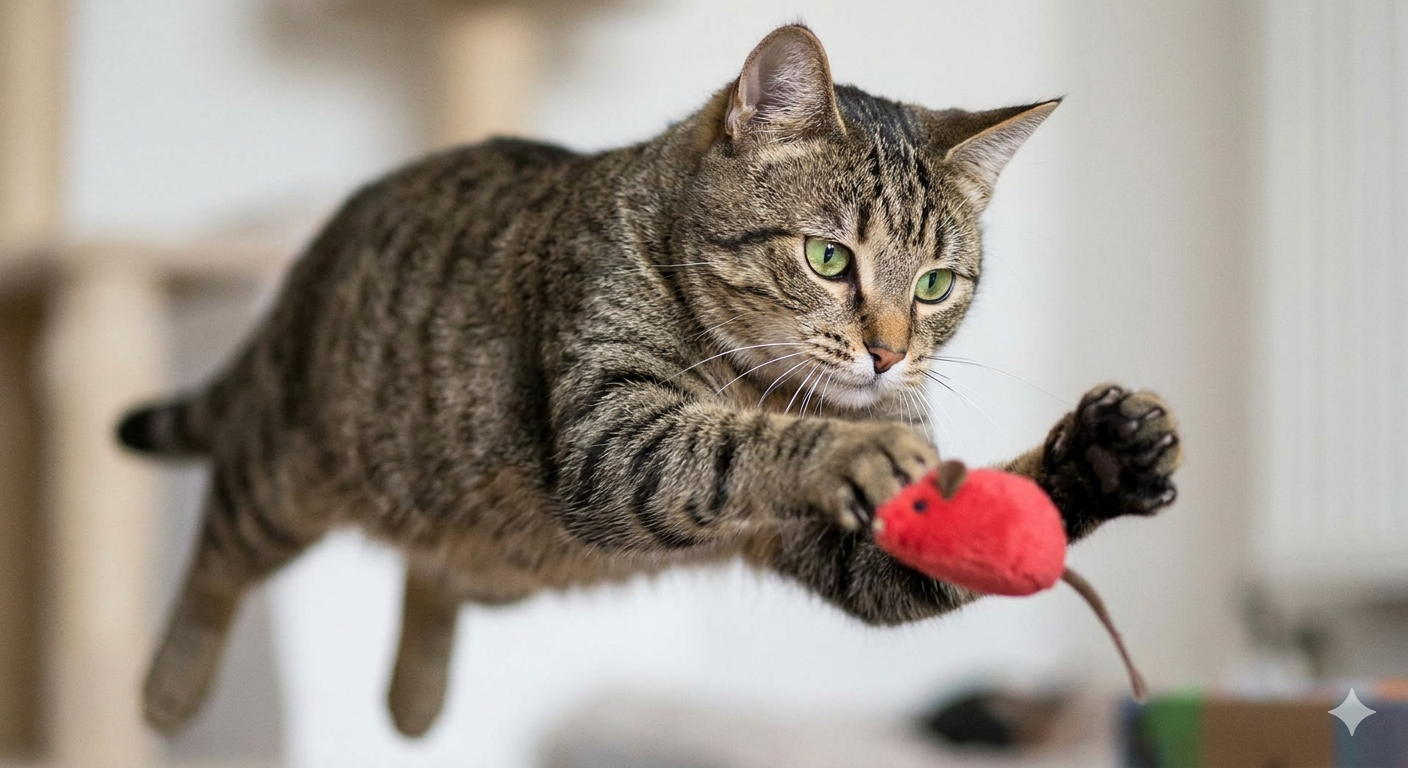
In the wild, cats are highly specialized, opportunistic hunters. Their survival depends on detecting and capturing tiny movements. When your cat sees a stationary object—a pen, a set of keys, or a decorative crystal—their primitive brain sometimes categorizes it as potential “prey.”
By batting at it, they are testing the object’s reaction. Will it scuttle away? Is it alive? Is it safe to pounce on? This “play” is often a rehearsal for hunting.
2. Attention-Seeking Behavior and Learned Association
Cats are masterful observers of cause-and-effect, especially regarding human behavior. They quickly learn that specific actions yield specific results.
If your cat is feeling ignored, they analyze what triggers a reaction from you. While sitting on your lap might get a gentle stroke, they have learned that the distinct sound of a glass hitting the hardwood floor results in you instantly running into the room. Even if you arrive yelling, you are giving them attention. In the mind of a bored cat, negative attention is still attention, and it’s better than being ignored.
3. Pure Boredom and Environmental Enrichment
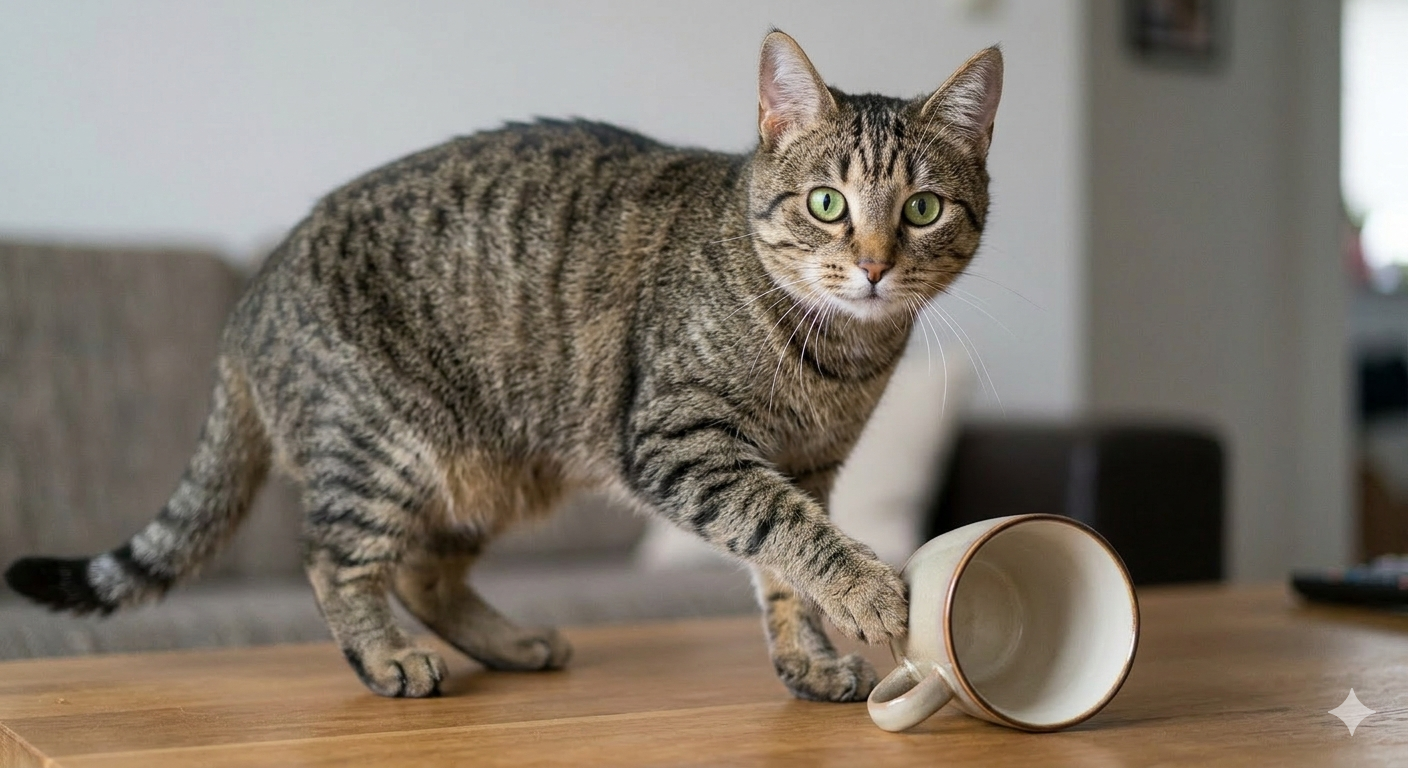
Indoor cats, while safe, often have a significant amount of unspent energy. If their environment is predictable and they don’t have enough interactive toys, puzzle feeders, or vertical space (like cat trees), they will invent their own games.
Knocking things off a table is, unfortunately, a very effective “game.” It involves:
- Physical exertion (the climb and the swat).
- Visual stimulation (watching the object fall).
- Auditory feedback (the crash).
- A social dynamic (your arrival).
4. Curiosity and Sensory Input
Cats interact with their world primarily through sight, scent, and touch. Their paws are incredibly sensitive, loaded with nerve endings. Sometimes, they knock something over simply because they are compelled by curiosity.
They want to know: Is it heavy? Is it slippery? What sound does it make when it hits the wooden table versus the tile floor? It’s a sensory investigation of their immediate environment.
How to Stop Your Cat from Knocking Things Over
You don’t have to live in a house with empty tables. Here are a few practical strategies to manage this feline behavior:
- Increase Interactive Play: Use wand toys to mimic hunting. Drain their energy with 10-15 minute sessions, especially before you sit down to work or relax.
- Don’t React to Non-Breakables: This is hard, but essential. If your cat knocks over a plastic bottle, do not look at them, do not speak, and do not get up immediately. Walk away. They must learn that this action results in being ignored.
- Clear the Runways: Keep valuables (glasses, crystals, electronics) in closed cabinets. For items that must stay out, consider using “Museum Wax” to temporarily secure them to the surface.
- Environmental Enrichment: Provide puzzle feeders that require your cat to “work” for their food using their paws. This redirects the instinctual swatting behavior to an appropriate, rewarding activity.
Frequently Asked Questions
Is my cat being mean when they break things?
No. Cats do not experience complex human emotions like “spite” or “revenge.” When they break things, they are usually just engaging in instinctual behavior or looking for a way to interact with you.
Do certain breeds knock things over more than others?
Generally, high-energy, highly intelligent breeds like Bengals, Abyssinians, and Siamese cats are often more prone to “investigative” knocking because they require significantly higher levels of mental stimulation and environmental enrichment.