You’ve managed to save $500 — and now you want it to work for you. That’s a smart move. A lot of people assume you need thousands of dollars before you can begin investing, but that’s simply not true anymore. Thanks to modern micro-investing apps, commission-free brokerages, and fractional shares, you can start building real wealth with just $500 today.
This guide walks you through exactly how to invest $500 for beginners — step by step, without the jargon. Whether you want to beat inflation, generate passive income, or simply grow your savings faster than a bank account allows, we have got you covered.
| 💡 Quick Fact Research consistently shows that people who start investing early — even with small amounts — accumulate significantly more wealth over time than those who wait until they have ‘enough’ money. The most important factor is getting started, not the size of your initial investment. |
Before You Invest: 3 Things to Do First
Jumping straight into the stock market without preparation is one of the most common beginner mistakes. Before you invest a single dollar, take care of these three things first.
1. Build a Small Emergency Fund
An emergency fund is money set aside for unexpected expenses — car repairs, medical bills, sudden job loss. If you don’t have one and something goes wrong, you’ll end up pulling your investment out early, often at a loss. Aim for at least $500–$1,000 in a high-yield savings account before investing. If your $500 is your emergency fund, build that up a little more before putting it into the market.
2. Pay Off High-Interest Debt First
If you’re carrying credit card debt at 20% or higher interest, paying that off first is literally the best investment you can make. No stock market return will consistently beat that interest rate. Once high-interest debt is cleared, you’re in a much stronger position to start investing.
3. Define Your Investment Goal
Ask yourself: Why am I investing this $500? Your answer shapes everything — which accounts to use, how much risk to take, and how long to keep your money invested. Common beginner goals include:
- Retirement savings — long-term horizon of 20-40 years
- Building wealth — medium-term horizon of 5-15 years
- Short-term goals — saving for a home, car, or travel within 1-3 years
The 7 Best Ways to Invest $500 for Beginners in 2025
Now let’s get into the actual investment options. Each one is beginner-friendly, low-barrier to entry, and proven to grow money over time.
1. Open a Roth IRA (Best for Long-Term Retirement)
If you’re investing for retirement, a Roth IRA is one of the smartest accounts a beginner can open. You contribute after-tax dollars, and your money grows completely tax-free. When you retire, you pay zero taxes on withdrawals — including all the gains you’ve built up over decades.
| Why It’s Perfect for Beginners You can open a Roth IRA with as little as $1 at brokerages like Fidelity or Charles Schwab. The 2025 annual contribution limit is $7,000 (or $8,000 if you’re over 50). Your $500 can go straight into an index fund inside the Roth IRA for maximum tax-free compounding over time. |
- Best for: Anyone under 50 with earned income and long-term wealth goals
- Where to open: Fidelity, Charles Schwab, or Vanguard — all have zero minimums and no annual fees
2. Invest in Index Funds and ETFs
An index fund or ETF (Exchange-Traded Fund) is a basket of stocks that tracks a market index like the S&P 500. Instead of trying to pick individual winning stocks — which is incredibly hard even for professionals — you own a tiny slice of hundreds of companies at once. This is called portfolio diversification, and it is the number one rule of smart investing.
| Index Fund / ETF | What It Tracks | Annual Expense Ratio | Min. Investment |
| VOO (Vanguard) | S&P 500 — 500 top US companies | 0.03% | $1 fractional |
| VTI (Vanguard) | Total US Stock Market | 0.03% | $1 fractional |
| SCHB (Schwab) | Broad US Market | 0.03% | $1 fractional |
| QQQ (Invesco) | NASDAQ-100 (tech-heavy) | 0.20% | $1 fractional |
| VT (Vanguard) | Total World Stock Market | 0.07% | $1 fractional |
Historically, the S&P 500 has returned an average of approximately 10% per year over the long term. That means your $500, invested today and left alone for 30 years, could grow to over $8,700 — without you adding another dollar. That is the power of compound interest, and it works best when you start early.
3. Use a Robo-Advisor for Hands-Off Investing
If you’d rather not choose your own funds, a robo-advisor does it for you automatically. These platforms ask about your financial goals and risk tolerance, then build and manage a diversified portfolio on your behalf using low-cost ETFs.
- Betterment — no minimum, automatic rebalancing, very beginner-friendly
- Wealthfront — $500 minimum, excellent tax-loss harvesting features
- SoFi Automated Investing — no management fees, includes free financial planning sessions
Robo-advisors typically charge a small annual fee between 0.25% and 0.50%, making them an affordable low-risk investment option for beginners who want professional-level portfolio management.
4. Buy Fractional Shares of Individual Stocks
With fractional shares, you can invest in companies like Apple, Amazon, or Google even if their full share price is well above $500. Platforms like Public, Robinhood, and Fidelity let you buy as little as $1 worth of any stock, making premium companies accessible at any budget.
| Important Warning Buying individual stocks is significantly riskier than index funds. A single company can lose most of its value quickly. If you choose this route, limit individual stock picks to no more than 20-30% of your total investment. Never put all your money in one stock. |
5. High-Yield Savings Account or Money Market Fund
If you are not ready to deal with market volatility, or you need the money within 1-2 years, a high-yield savings account (HYSA) or money market fund is a smart, safe option. In 2025, top HYSAs are offering 4.5% to 5.2% APY — dramatically better than a standard checking account earning 0.01%.
- Marcus by Goldman Sachs — consistently high APY, fully FDIC insured
- Ally Bank — no minimum deposit, easy online transfers, no hidden fees
- SoFi High-Yield Savings — bonus APY when you set up direct deposit
6. Micro-Investing Apps
Apps like Acorns and Stash are built specifically for beginner investors with small amounts of money. Acorns, for example, rounds up your everyday purchases to the nearest dollar and invests the difference automatically. With $500 as an initial lump sum, you can set it up and also have spare-change investing working for you passively every day.
These platforms invest in diversified portfolios of ETFs, making them safe for beginners while quietly building the habit of regular investing — which is arguably just as valuable as the returns themselves.
7. Invest in Yourself
This one sounds cliche, but it is backed by data. Spending $500 on a high-quality online course, professional certification, or in-demand skill that directly increases your earning potential can generate returns no stock will match. A $500 investment in learning data analysis, coding, copywriting, or digital marketing could directly lead to a significant salary increase or a new freelance income stream.
| Pro Tip Platforms like Coursera, LinkedIn Learning, and Udemy regularly run sales where top courses cost just $15-$30. With $500, you could take 10-15 career-transforming courses and completely reshape your income trajectory within a year. |
How to Split Your $500: A Practical Allocation Plan
Here’s a balanced breakdown of how to allocate your $500 if you want to balance long-term growth with some safety:
| Allocation | Amount | Where to Put It | Why |
| Roth IRA (Retirement) | $200 | Fidelity or Schwab — VOO or FXAIX index fund | Tax-free long-term compounding |
| Index Fund / ETF | $150 | Brokerage account — VTI or VOO | Diversified market-linked growth |
| High-Yield Savings | $100 | Ally Bank or Marcus HYSA | Safe buffer earning 4-5% APY |
| Self-Investment | $50 | Udemy or Coursera course | Potentially the highest ROI |
You can absolutely customize this based on your personal goals and timeline. The key principle is simple: do not let $500 sit idle in a checking account earning near-zero interest. Even a modest, diversified investment plan started today will significantly outperform doing nothing.
Understanding Risk: What Every Beginner Needs to Know
Every investment carries some level of risk. Here is a simple risk spectrum to help you understand where each option sits, so you can make choices that match your personal comfort level:
| Risk Level | Investment Type | Potential Annual Return | Best For |
| Very Low | HYSA / Money Market Fund | 4-5% APY (guaranteed) | Short-term, safety-first investors |
| Low-Medium | S&P 500 Index Funds / ETFs | 7-10% average over time | Long-term wealth building |
| Medium | Robo-Advisor Portfolio | 6-9% average over time | Hands-off beginner investors |
| Medium-High | Individual Stocks | Highly variable | Research-ready investors |
| High | Cryptocurrency / Options | Unpredictable, can lose all | Experienced investors only |
As a beginner, stick firmly to low-to-medium risk options. The goal is not to get rich overnight — it’s to build consistent, reliable wealth over time. Warren Buffett himself has said repeatedly that low-cost index funds are the best investment most people can make.
The Power of Compound Interest: What $500 Can Become
One of the most powerful forces in personal finance is compound interest — earning returns on your returns. Here’s how your $500 could realistically grow over time at different average annual rates:
| Time Period | $500 at 5% (HYSA) | $500 at 7% (ETF avg) | $500 at 10% (S&P 500 avg) |
| 5 Years | $638 | $702 | $805 |
| 10 Years | $814 | $984 | $1,297 |
| 20 Years | $1,327 | $1,934 | $3,364 |
| 30 Years | $2,161 | $3,806 | $8,725 |
| 40 Years | $3,520 | $7,485 | $22,626 |
These numbers assume you never add another dollar after the initial $500. Now imagine adding just $50 per month on top of that. Over 30 years at a 10% average return, that monthly $50 alone grows to over $100,000. That’s the reason every financial expert agrees: starting early is the single most important factor in building wealth.
5 Common Beginner Investing Mistakes to Avoid
Knowing what NOT to do is just as important as knowing what to do. Here are the biggest mistakes new investors make — and how to avoid them.
- Trying to time the market. Nobody — not even professional fund managers — can consistently predict when markets will rise or fall. The strategy that works is simple: invest regularly and stay invested.
- Panic selling during a market dip. Markets go down sometimes. That’s normal. Selling at a loss locks in that loss permanently. Historically, every major market downturn has been followed by a full recovery and new highs. Stay calm, stay invested.
- Putting everything in one stock. Diversification protects you. Never concentrate your $500 in a single company, no matter how confident you feel about it.
- Ignoring fees and expense ratios. A 1% annual fee sounds tiny, but over 30 years it can cost you tens of thousands in lost compound growth. Always use low-cost index funds with expense ratios below 0.10%.
- Waiting for the ‘perfect moment’ to invest. There is no perfect moment. Markets are always uncertain. The best time to invest is now. The second best is tomorrow. Waiting costs you compounding time you can never get back.
Frequently Asked Questions
Can I really invest with just $500?
Absolutely. Most major brokerages including Fidelity, Charles Schwab, and Robinhood have no account minimums whatsoever. You can open an account and start investing today with $500, $50, or even $5. Fractional shares mean no stock or ETF is out of reach at any budget.
Is investing $500 in stocks risky for beginners?
It depends entirely on how you invest it. Putting $500 into a single stock carries meaningful risk. Putting $500 into a broad S&P 500 index fund like VOO is much lower risk because you are instantly diversified across 500 large companies. Historically, over any 15-year period, the S&P 500 index has never finished with a net loss.
What is the best app to invest $500 as a beginner?
For most beginners, Fidelity and Charles Schwab are the most trusted options — both have zero minimums, excellent educational resources, and fractional share investing. Acorns and Betterment are great if you prefer completely hands-off, automated investing. All four are beginner-friendly with minimal fees.
How long should I keep $500 invested?
The longer you keep it invested, the more compound interest works in your favour. Even a 5 to 10 year horizon produces meaningful gains. For a Roth IRA aimed at retirement, think 20 to 40 years. The key rule: only invest money you genuinely will not need in the short term.
What is the safest investment for beginners in 2025?
For capital preservation, high-yield savings accounts (FDIC insured, 4-5% APY) and US Treasury bonds are the safest options. For market-based investing with low risk, broad index funds like VOO or VTI are considered the safest choice due to their instant diversification across hundreds of companies.
What is dollar-cost averaging and should I use it?
Dollar-cost averaging (DCA) means investing a fixed amount on a regular schedule — say, $50 every month — rather than investing a lump sum all at once. It removes the stress of ‘timing the market’ and means you automatically buy more shares when prices are low and fewer when prices are high. For beginners, DCA is one of the most effective and stress-free strategies available.
Final Thoughts: Start Investing Your $500 Today
Here’s the bottom line: $500 is enough to start building real, lasting wealth. You don’t need to be rich to invest — you invest to get rich. The hardest part isn’t choosing the right ETF or picking the right platform. The hardest part is simply starting.
If you’re not sure where to begin, here’s the simplest possible action: open a Roth IRA at Fidelity, deposit your $500, invest it in VOO or FXAIX (Fidelity’s zero-fee S&P 500 fund), and set up a small automatic monthly contribution — even $25 or $50 a month. Then leave it alone.
Markets will go up. Markets will occasionally go down. But over the long term, investing consistently beats sitting on cash every single time. Your future self will be deeply grateful you started today rather than waiting for ‘the right moment’ that never comes.
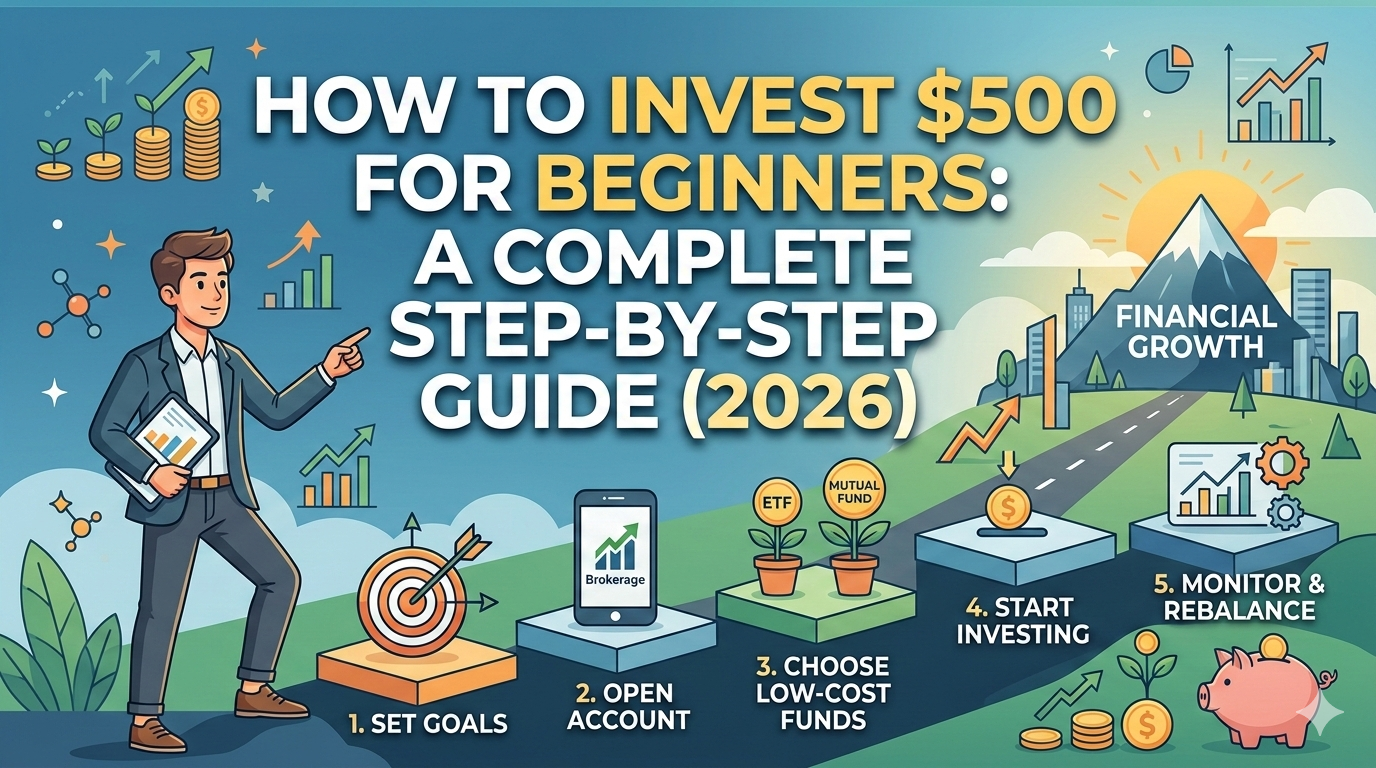
| Your Action Steps This Week Step 1: Open a free Roth IRA at Fidelity or Charles Schwab (takes about 10 minutes online) Step 2: Transfer your $500 and invest in VOO, VTI, or FXAIX Step 3: Set up an automatic monthly contribution of $25, $50, or whatever you can afford Step 4: Leave it alone and let time and compound interest do the heavy lifting |