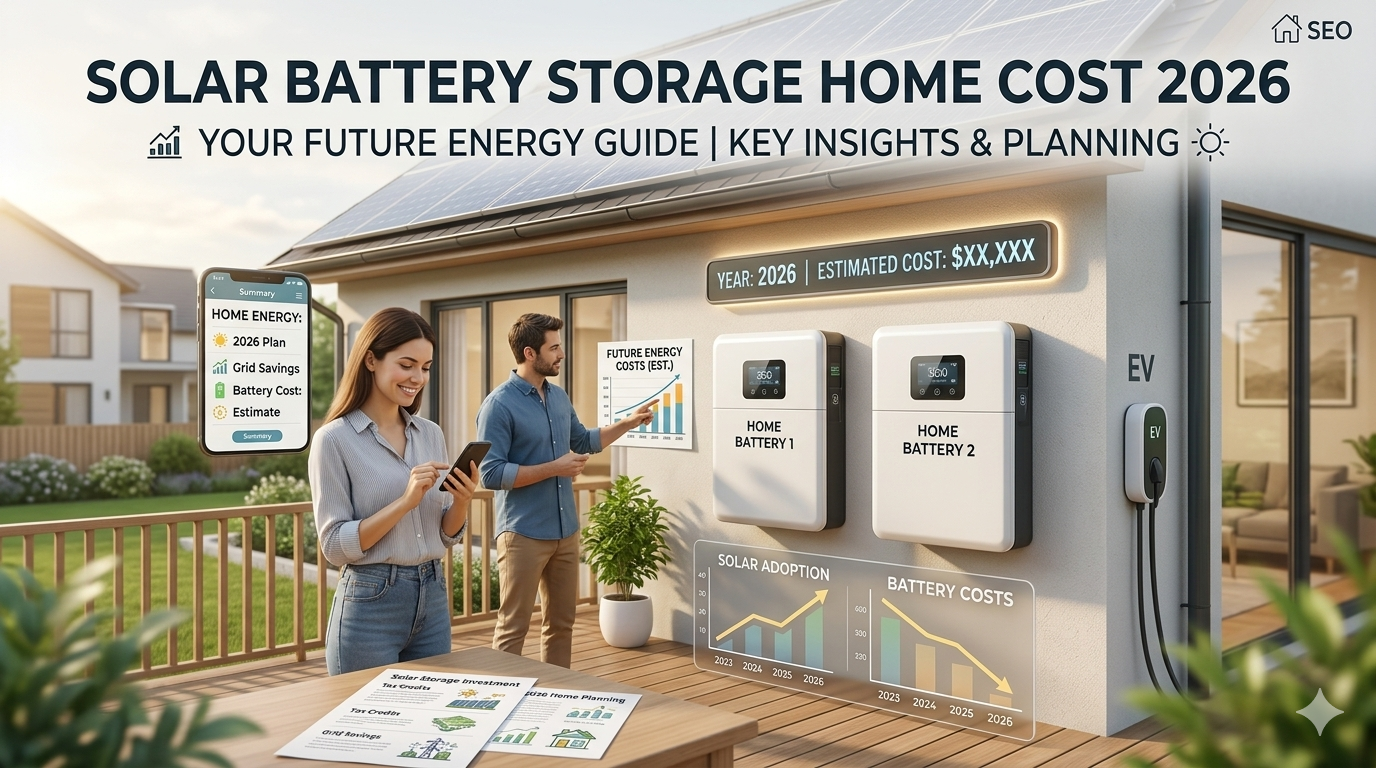
If you’re considering investing in solar battery storage for your home, 2026 is shaping up to be one of the best years to act. Battery costs have dropped significantly compared to just three years ago, federal incentives remain strong, and the technology has matured enough to deliver real, measurable savings on your energy bills. Yet many homeowners still feel uncertain about the actual numbers — what does a home solar battery system actually cost to purchase and install, and when will it pay for itself?
This in-depth guide answers every question you’re likely to have about residential solar battery storage costs in 2026, from upfront pricing and installation fees to ongoing maintenance, available tax credits, and realistic return on investment timelines. Whether you’re just starting to explore solar energy storage options or you’re ready to get quotes, this resource will give you the knowledge to make a confident, informed decision.
What Is Home Solar Battery Storage?
Home solar battery storage refers to a rechargeable battery system that stores excess electricity generated by your rooftop solar panels. Instead of sending surplus power back to the grid at low compensation rates, a home energy storage system lets you bank that energy and use it later — during the evening, on cloudy days, or during a grid outage.
Modern residential battery backup systems are typically lithium iron phosphate (LFP) or lithium nickel manganese cobalt (NMC) batteries housed in sleek wall-mounted or floor-standing enclosures. They pair seamlessly with both new and existing solar panel systems, and many come with smart energy management software that optimizes when to charge and discharge based on your usage patterns, utility rates, and solar production forecasts.
The growing popularity of solar plus storage systems is driven by three key trends: rising electricity rates nationwide, the push for energy independence, and the expanding availability of time-of-use (TOU) billing by utilities, which charges more for power used during peak hours. A well-sized solar battery bank lets you sidestep those peak rates entirely.
Solar Battery Storage Home Cost 2026: The Numbers
The single most common question homeowners ask is: how much does solar battery storage cost for a home in 2026? The honest answer is that it varies depending on battery capacity, brand, installation complexity, and location — but the ranges below reflect real-world market pricing as of early 2026.
Average Cost by Battery Capacity
| Battery Size | Equipment Cost | Installed Cost (w/ labor) |
| 5 – 7 kWh (Small) | $4,000 – $7,500 | $6,000 – $10,500 |
| 10 – 13 kWh (Mid-Range) | $8,000 – $14,000 | $11,000 – $18,000 |
| 20 – 27 kWh (Large) | $14,000 – $24,000 | $18,000 – $32,000 |
These figures represent the total cost of solar battery storage including the battery unit, inverter (if not already installed), mounting hardware, electrical wiring, and professional labor. The wide ranges reflect differences in regional labor rates, home electrical panel requirements, and whether you’re retrofitting an existing solar system or bundling everything in a new solar panel and battery installation.
How Does Battery Capacity Affect Cost?
Battery capacity is measured in kilowatt-hours (kWh) and determines how much energy your system can store. A typical American home uses about 30 kWh per day, so a single 10 – 13 kWh battery won’t cover all your needs overnight — but it can power your essential loads (refrigerator, lights, HVAC, phone charging) for 8 to 12 hours during an outage or after sunset.
Many homeowners choose stackable battery systems that allow them to add capacity over time. Popular options like the Tesla Powerwall 3, Enphase IQ Battery, and Franklin Electric aPower are all modular, meaning you can start with one unit and expand as your budget allows or your energy needs grow.
Top Solar Battery Brands and Their 2026 Pricing
The best home solar batteries in 2026 come from a range of manufacturers, each with different strengths in terms of capacity, warranty, chemistry, and integration with solar inverters. Here is a breakdown of the most popular residential solar battery brands and their approximate 2026 pricing.
Tesla Powerwall 3
The Tesla Powerwall 3 remains one of the most recognized names in home battery storage. It offers 13.5 kWh of usable capacity, a built-in solar inverter, and seamless integration with the Tesla app. The equipment cost runs approximately $9,200 to $11,500, with total installed cost typically ranging from $12,000 to $16,500 depending on your location and installer.
Enphase IQ Battery 5P
Enphase’s modular approach appeals to homeowners who want flexibility. Each IQ Battery 5P unit stores 5 kWh and can be stacked. For a 10 kWh system, expect to pay $7,500 to $10,000 for equipment and $11,000 to $14,500 fully installed. Enphase batteries pair perfectly with their microinverter systems and feature excellent monitoring via the Enlighten app.
SolarEdge Home Battery
The SolarEdge Home Battery (48V, 9.7 kWh usable) integrates tightly with SolarEdge’s power optimizer inverters. Equipment pricing hovers around $6,500 to $9,000, with installation pushing the total solar battery storage cost to approximately $9,500 to $13,500.
Franklin Electric aPower 2
Franklin’s aPower 2 is a 13.6 kWh AC-coupled battery that works with virtually any inverter, making it one of the best retrofit solar battery options for homeowners with existing solar systems. Pricing typically runs $8,000 to $11,000 for equipment, with fully installed costs around $11,500 to $16,000.
LG RESU Prime
The LG RESU Prime series (10H and 16H models) offers high energy density in a compact form factor. The 16H model (16 kWh) runs approximately $8,500 to $12,000 for equipment and $12,000 to $17,000 installed. LG batteries are known for reliability and are backed by a strong 10-year warranty.
What Affects the Cost of Solar Battery Storage?
Understanding what drives solar battery storage pricing helps you negotiate better and make smarter choices. Multiple variables can push your total home energy storage system cost up or down significantly.
1. Battery Chemistry
Lithium iron phosphate (LFP) batteries are increasingly dominant in the residential market in 2026 because of their superior safety profile, longer cycle life (3,000–6,000 cycles), and better performance in high-temperature environments. NMC batteries offer higher energy density in a smaller package but typically have shorter lifespans. LFP units generally cost slightly more upfront but deliver better long-term cost per kWh of storage.
2. AC vs. DC Coupling
DC-coupled batteries connect directly to your solar array before the inverter, which is more efficient but requires a compatible inverter. AC-coupled battery systems connect after the inverter, making them ideal for adding battery storage to an existing solar system. AC-coupled systems are slightly less efficient (losing about 5–8% in conversion) but more versatile and easier to install, which can lower labor costs.
3. Electrical Panel Upgrades
Many older homes need an electrical panel upgrade to accommodate a battery system, particularly if the existing panel is 100-amp service or has no available breaker slots. A panel upgrade adds $1,500 to $3,500 to the total project cost but is often necessary to ensure safe, code-compliant installation of your residential energy storage system.
4. Whole-Home vs. Partial Backup
A whole-home solar battery backup system that powers everything in your house — including central air conditioning, electric water heaters, and EV chargers — requires significantly more capacity (and cost) than a critical loads backup system that only powers essentials. Most homeowners in 2026 opt for a hybrid approach: a 10 to 20 kWh system that covers essential appliances with the option to add more batteries later.
5. Installation Labor Costs
Solar battery installation costs vary widely by region. In high-cost-of-living states like California, Massachusetts, and New York, labor can add $3,000 to $6,000 to the total. In the South and Midwest, the same work might cost $1,500 to $3,000. Permitting fees, utility interconnection charges, and local inspection requirements also vary by jurisdiction and contribute to regional cost differences.
Federal Tax Credits and Solar Battery Storage Incentives in 2026
One of the most powerful reasons to invest in home battery storage in 2026 is the availability of substantial financial incentives that dramatically reduce your net cost.
The Federal Investment Tax Credit (ITC)
Under the Inflation Reduction Act, the federal solar tax credit — officially called the Residential Clean Energy Credit — provides a 30% tax credit on the cost of a qualifying solar battery storage system. In 2026, this credit applies to both solar panels and battery storage, even if the battery is installed separately from a solar system (as long as it is charged by renewable energy at least 80% of the time).
For a $15,000 solar panel battery storage system, a 30% ITC translates to a $4,500 federal tax credit, bringing your effective cost down to $10,500. This is a dollar-for-dollar reduction in your federal tax liability, not just a deduction — making it one of the most valuable solar energy incentives available to homeowners.
State and Utility Rebates
Beyond the federal credit, many states and utilities offer additional incentives for home solar battery storage. Some notable 2026 programs include California’s SGIP (Self-Generation Incentive Program), which provides rebates of up to $1,000 per kWh for low-income households and wildfire-prone areas; New York’s Con Edison and PSEG battery incentives; and numerous utility programs in Texas, Florida, Massachusetts, and Hawaii that offer bill credits for grid-interactive battery systems.
When you combine all available solar battery rebates and incentives, it’s not uncommon for total incentives to offset 30 to 50% of the gross installation cost, fundamentally changing the economics of residential solar energy storage.
Solar Battery Storage ROI and Payback Period
When evaluating solar battery storage as a home investment, the most important metric is the payback period — how long it takes for your energy savings to equal what you spent. In 2026, typical payback periods for residential battery systems range from 7 to 14 years, depending on electricity rates, incentives, and usage patterns.
How Savings Are Generated
A solar battery storage system generates savings in several distinct ways. First, by storing solar energy during the day and using it at night, you reduce the amount of power you buy from the grid, which is particularly valuable under time-of-use (TOU) rate structures where evening electricity rates can be two to three times higher than midday rates. Second, in states with net metering, optimizing when you export versus self-consume can meaningfully boost your return. Third, participating in virtual power plant (VPP) programs — offered by utilities in California, Texas, Massachusetts, and growing numbers of states — allows you to earn credits by allowing the utility to dispatch your battery during grid stress events.
Break-Even Analysis Example
Consider a homeowner in California who installs a 13.5 kWh Tesla Powerwall 3 for a total installed cost of $14,500. After the 30% federal ITC ($4,350), their net cost is $10,150. If they’re on a TOU rate and save $1,200 per year by charging from solar and discharging during peak hours, plus earn an additional $300 per year from a VPP program, their annual benefit is $1,500. At that rate, they’ll break even in approximately 6.8 years — well within the battery’s 10-year warranty period.
Solar Battery Storage vs. Generator: Which Is Better in 2026?
Many homeowners considering whole-home backup power compare solar battery storage to a traditional standby generator. Both have merits, but the calculus has shifted decisively in favor of batteries for most residential applications in 2026.
- Solar batteries provide silent, emissions-free backup with zero fuel cost and near-instant switchover during an outage.
- Propane and natural gas generators can run indefinitely with a fuel supply but require regular maintenance, produce noise and fumes, and cost $5,000 to $15,000 installed for a whole-home unit.
- Solar batteries paired with solar panels can recharge during a multi-day outage as long as the sun is shining, making them more resilient in extended blackouts than generators dependent on fuel delivery.
- In high-wildfire-risk or hurricane-prone areas, the grid reliability benefits of a solar-plus-storage system are increasingly being recognized by homeowner’s insurers, some of whom now offer policy discounts.
How to Choose the Right Solar Battery Storage System for Your Home
With so many residential solar battery options available in 2026, narrowing down the right system requires a structured approach. Here are the key steps most energy experts recommend.
- Audit your energy usage first. Pull 12 months of utility bills to understand your average daily kWh consumption, peak demand patterns, and the hours when you’re most vulnerable to outages.
- Determine your backup priority. Decide whether you want whole-home coverage or just essential loads backup, as this will define the minimum capacity you need.
- Check inverter compatibility. If you already have solar, confirm which battery brands are compatible with your existing inverter before getting quotes.
- Get at least three quotes. Solar battery storage installation costs vary by 20 to 40% between installers. Use platforms like EnergySage, Solar-Estimate, or Sunrun to compare offers in your area.
- Verify licensing and insurance. Your installer should be NABCEP-certified, fully licensed in your state, and carry both liability and workers’ compensation insurance.
- Understand the warranty. Look for at least a 10-year product warranty and a minimum end-of-warranty capacity retention guarantee of 70% or higher.
Solar Battery Maintenance Costs and Lifespan
One advantage of lithium-ion home batteries over other energy storage technologies is their remarkably low maintenance requirements. Unlike lead-acid batteries, there’s no watering, equalization charging, or ventilation management needed. Most home solar battery systems in 2026 are essentially plug-and-forget devices.
The primary ongoing consideration is battery degradation, which is the gradual decline in maximum storage capacity over time. Most LFP batteries degrade at approximately 2 to 3% per year, meaning a 13 kWh battery will still hold about 10.7 kWh after 10 years. Manufacturers account for this in their warranties, guaranteeing a minimum capacity (typically 70–80%) at the end of the warranty period.
Software updates are delivered over Wi-Fi automatically for most modern systems, and some manufacturers offer optional monitoring plans for $5 to $15 per month that provide detailed analytics and proactive issue alerts. Overall, expect annual solar battery maintenance costs of $0 to $200 for most homeowners over the system’s life.
Is Solar Battery Storage Worth It in 2026?
This is ultimately the question every homeowner needs to answer for their own situation. The financial case for residential solar battery storage has never been stronger than it is in 2026, driven by three converging forces: continued cost reductions in battery technology, rising and increasingly volatile electricity rates, and the sustained availability of the 30% federal tax credit.
For homeowners in states with high electricity costs, frequent outages, or robust battery incentive programs — California, Texas, Florida, Massachusetts, Hawaii, and New York in particular — a solar panel and battery storage system can deliver payback periods under 8 years and lifetime savings well over $30,000 on a 25-year horizon. For homeowners in states with lower electricity rates and limited incentives, the financial case is thinner but the resilience benefits are still substantial.
Beyond pure economics, the intangible value of energy independence, the peace of mind from knowing your home is protected during an outage, and the environmental benefit of maximizing self-consumption of clean solar energy are reasons many homeowners find the investment worthwhile even in markets with longer payback periods.
Frequently Asked Questions
How much does it cost to add battery storage to an existing solar system?
Adding a battery to an existing solar system in 2026 typically costs between $8,000 and $18,000 fully installed for a 10–13 kWh unit, before incentives. The 30% federal ITC applies even to retrofit installations, reducing the net cost to approximately $5,600 to $12,600. AC-coupled batteries like the Franklin aPower 2 or Enphase IQ Battery are the easiest to add to an existing system without replacing your inverter.
What size battery do I need to power my house?
For whole-home solar battery backup, most homes need between 20 and 40 kWh of storage capacity to cover a full day’s usage. For essential loads only (refrigerator, lights, some outlets, and a HVAC fan), a single 10–13 kWh battery is typically sufficient for 8–12 hours of backup. A licensed solar installer can perform a proper load calculation to recommend the right capacity for your specific home.
Can I get solar battery storage without solar panels?
Yes — you can install a standalone home battery system without solar panels, using it purely as a grid storage device to charge during off-peak hours and discharge during peak hours. However, the federal 30% tax credit only applies if the battery is charged by solar energy at least 80% of the time, so a grid-only battery won’t qualify for this incentive. Standalone batteries still make financial sense in some high-TOU-rate markets.
How long do solar batteries last?
Modern lithium iron phosphate solar batteries are rated for 3,000 to 6,000 complete charge cycles, which translates to roughly 10 to 15 years of useful life for a daily-cycling residential application. Most manufacturers back their batteries with a 10-year product warranty guaranteeing at least 70% of original capacity at the end of the term. After the warranty period, batteries don’t typically fail outright — they simply have reduced capacity, and many homeowners continue using them for years beyond the warranty.
Do solar batteries qualify for the 30% federal tax credit in 2026?
Yes. Under the Inflation Reduction Act’s Residential Clean Energy Credit, qualifying solar battery storage systems receive a 30% federal tax credit in 2026. The battery must have a capacity of at least 3 kWh and must be charged by a renewable energy source at least 80% of the time. This credit is scheduled to remain at 30% through 2032, making 2026 an excellent time to lock in the maximum incentive.
What is the best solar battery for home use in 2026?
The best residential solar battery depends on your priorities. For overall performance and brand reliability, the Tesla Powerwall 3 and Enphase IQ Battery 5P are top-rated choices. For retrofit flexibility, the Franklin aPower 2 excels. For compact, high-efficiency installations, the LG RESU Prime 16H is an excellent option. The “best” battery for your home is ultimately the one that is properly sized, compatible with your existing or planned solar system, and backed by a certified local installer.
How long does it take to install a solar battery system?
A standard home solar battery installation takes 1 to 3 days from permit approval to final inspection. The permitting process itself — which involves submitting designs to your local building department and utility — typically takes 2 to 8 weeks depending on jurisdiction. Planning ahead is essential: if you want a system operational before summer, the ideal time to begin the process is late winter or early spring.
Will a home battery increase my property value?
Research from Lawrence Berkeley National Laboratory and other sources consistently shows that solar systems increase home resale value. While data specific to standalone batteries is more limited, studies suggest that solar plus storage systems command a premium of $10,000 to $30,000 over comparable non-solar homes in high-electricity-cost markets. Real estate agents in California, New York, and Hawaii increasingly cite solar batteries as a key selling point.
Final Thoughts: Is 2026 the Right Time to Invest?
The solar battery storage home cost in 2026 represents the best value proposition the market has ever seen. Prices have dropped, incentives are strong, and the technology is proven. The combination of a 30% federal tax credit, falling battery prices, rising electricity rates, and growing grid instability means the question for many homeowners is no longer “if” — it’s “when” and “how much capacity.”
Start by getting multiple quotes from certified solar battery installers in your area, confirm your eligibility for state and utility incentives, and run the numbers with a realistic estimate of your local electricity rates. Whether your primary motivation is saving money, achieving energy independence, protecting your family during outages, or reducing your carbon footprint, 2026 is an outstanding year to make the leap into residential solar battery storage.