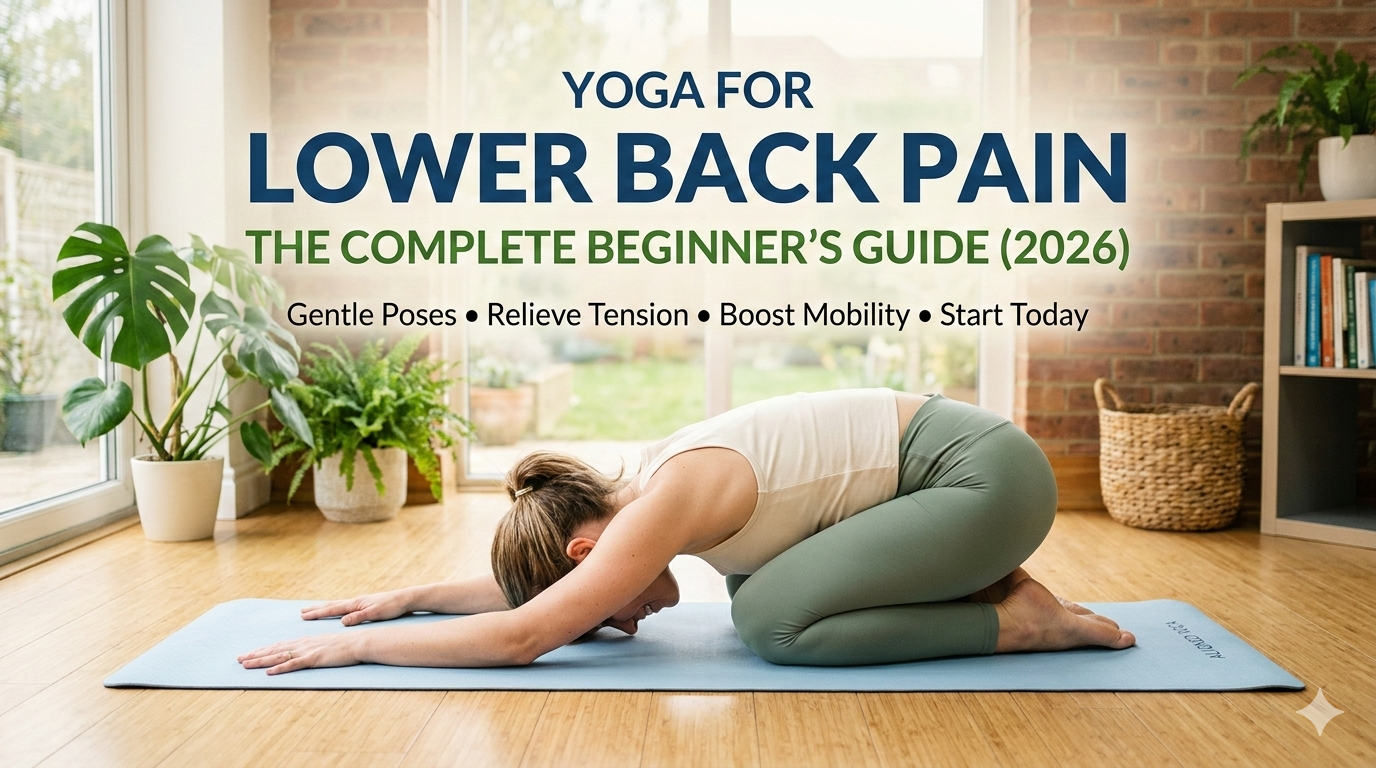
Suffering from lower back pain? You are not alone. Millions of people experience chronic or recurring back discomfort — but here is the good news: a consistent practice of yoga for lower back pain can bring real, lasting relief. This beginner-friendly guide walks you through everything you need to know, from the science behind why yoga works, to a step-by-step 20-minute routine you can start at home today.
| Quick Answer Yes — yoga is one of the most effective low-impact treatments for lower back pain. Gentle poses like Child’s Pose, Cat-Cow, and Supine Twist target the lumbar spine, hip flexors, and surrounding muscles to reduce tightness, improve posture, and build core strength — all without stressing painful joints. |
Why Does Your Lower Back Hurt? (And How Yoga Helps)
Before diving into the poses, it helps to understand what is causing your lower back pain. The majority of cases are not caused by serious structural damage. Instead, they come down to three main culprits:
- Tight hip flexors: Sitting for long hours shortens these muscles, tilting the pelvis forward and compressing the lumbar spine.
- Weak core muscles: When the abdominals and deep stabilizers are weak, the lower back overworks — leading to chronic strain and fatigue.
- Poor posture and body mechanics: Slouching collapses the spine’s natural curves, creating uneven pressure on the discs and vertebrae.
Yoga for back pain relief directly addresses all three issues. It stretches tight muscles, builds functional strength, and retrains postural habits. Research published in the Annals of Internal Medicine found that yoga is as effective as physical therapy for reducing chronic lower back pain in adults — making it one of the most evidence-backed natural treatments available.
Is Yoga Safe for Beginners With Lower Back Pain?
Absolutely — with a few important ground rules. Beginner yoga for back pain is safe and gentle when practiced correctly. Follow these guidelines:
- Always warm up with gentle movement before deeper stretches — never stretch cold muscles.
- Move slowly and never force a pose past your comfortable range of motion.
- Avoid deep forward folds or extreme twists if you have a disc herniation — consult your doctor first.
- Use props: yoga blocks, folded blankets, or bolsters reduce strain and support alignment.
- Stop immediately if you feel sharp, shooting, or worsening pain of any kind.
| Important Safety Note If your back pain is related to a herniated disc, sciatica, spinal stenosis, osteoporosis, or a recent injury, please consult your doctor or physical therapist before beginning any yoga routine. This guide addresses general lower back stiffness and muscle-related discomfort. |
10 Best Yoga Poses for Lower Back Pain (Beginner-Friendly)
The following yoga stretches for lower back pain are specifically chosen for beginners. They are gentle, require no equipment beyond a yoga mat, and can be completed in under 20 minutes. Here is a quick overview, followed by detailed instructions for each pose:
| Pose Name | Duration | Difficulty | Key Benefit |
| Child’s Pose (Balasana) | 30-60 sec | Beginner | Releases lower back tension |
| Cat-Cow Stretch | 8-10 reps | Beginner | Mobilizes & lubricates spine |
| Supine Twist | 30 sec/side | Beginner | Stretches piriformis & lumbar |
| Knee-to-Chest Pose (Apanasana) | 30-60 sec | Beginner | Gently decompresses lumbar |
| Sphinx Pose | 30-60 sec | Beginner | Gentle therapeutic backbend |
| Bridge Pose (Setu Bandhasana) | 30-60 sec | Easy | Strengthens glutes & back |
| Downward-Facing Dog | 30-45 sec | Easy | Lengthens spine & hamstrings |
| Seated Forward Fold | 30-45 sec | Easy | Stretches lower back & hips |
| Pigeon Pose | 45 sec/side | Moderate | Opens hips, relieves sciatica |
| Legs Up the Wall | 5 minutes | Beginner | Decompresses spine fully |
1. Child’s Pose (Balasana) — The Ultimate Back Reset
Child’s Pose is the foundational resting yoga pose for back pain. It gently elongates the lumbar spine, releases hip tension, and activates the parasympathetic nervous system — shifting your body out of the “fight or flight” stress state that amplifies pain perception.
How to do it:
- Start on all fours. Bring your big toes together and widen your knees to hip-width apart.
- Slowly sink your hips back toward your heels, stretching your arms forward on the mat.
- Rest your forehead down. Close your eyes and breathe deeply for 30-60 seconds.
- Feel your lower back expand with each inhale and soften with each exhale.
Tip: Place a folded blanket under your seat if your hips do not comfortably reach your heels.
2. Cat-Cow Stretch — Mobilize and Lubricate the Spine
Cat-Cow is among the most widely recommended yoga exercises for lumbar pain. This flowing movement lubricates the spinal facet joints, reduces morning stiffness, and massages the muscles along the vertebral column.
- Begin in a tabletop position — hands under shoulders, knees under hips.
- Inhale: Drop your belly toward the floor, lift your chest and tailbone upward (Cow Pose).
- Exhale: Round your spine toward the ceiling, tuck your chin and pelvis (Cat Pose).
- Flow between the two positions for 8-10 slow, connected breath cycles.
3. Supine Twist (Supta Matsyendrasana) — Release the Lumbar and Piriformis
This spinal decompression yoga pose is excellent for releasing the piriformis muscle — a common trigger for lower back and sciatica pain. It also gently rotates the thoracic and lumbar spine, releasing adhesions built up from repetitive sitting.
- Lie on your back with knees bent, feet flat on the floor.
- Drop both knees slowly to the right side. Extend your arms out in a T-shape.
- Turn your gaze to the left. Breathe slowly and allow the twist to deepen naturally.
- Hold for 30 seconds, then return to center. Repeat on the left side.
4. Knee-to-Chest Pose (Apanasana) — Gentle Lumbar Decompression
This simple pose gently stretches the lower back, glutes, and hip flexors while relieving compression between the lumbar vertebrae — making it a perfect warm-up before deeper yoga poses for back pain.
- Lie flat on your back. Hug both knees into your chest.
- Gently rock side to side for a soothing massage along the lumbar spine.
- For a deeper stretch, straighten one leg and hold the other knee for 30-45 seconds, then switch.
5. Sphinx Pose — A Therapeutic Backbend for Disc Health
Sphinx Pose is a gentle yoga backbend for lower back pain that encourages the natural lumbar curve. It is especially helpful if you spend long hours sitting, which flattens the lumbar curve and increases disc pressure.
- Lie on your stomach. Prop yourself up on your forearms, elbows under your shoulders.
- Press your forearms down and lift your chest slightly. Keep your hips on the floor.
- Breathe slowly and hold for 30-60 seconds. You should feel a gentle arch in the lower back — not pain.
6. Bridge Pose (Setu Bandhasana) — Build Glute and Back Strength
Bridge Pose strengthens the glutes, hamstrings, and spinal extensors — the muscles that support the lower back and are almost always weak in people with chronic back pain. Stronger posterior chain muscles mean less load on the lumbar spine.
- Lie on your back, knees bent, feet flat on the floor hip-width apart.
- Press your feet firmly down and lift your hips toward the ceiling.
- Squeeze your glutes at the top and hold for 5 deep breaths.
- Lower slowly. Repeat 8-10 times.
7. Downward-Facing Dog — Full Spine Lengthener
Downward Dog is a classic yoga pose for spinal traction. It decompresses the lumbar spine while simultaneously stretching the hamstrings and calves — two muscle groups that, when tight, dramatically increase lower back tension.
- Start in a tabletop position. Tuck your toes and lift your hips up and back.
- Straighten your legs as much as comfortable (a slight bend is fine for beginners).
- Press your palms flat, lengthen your spine, and breathe for 30-45 seconds.
8. Legs Up the Wall (Viparita Karani) — Decompress and Recover
This restorative yoga pose for back pain uses gravity to gently decompress the lumbar vertebrae. It is especially helpful after a long day of sitting, standing, or physical activity.
- Sit sideways against a wall. Swing your legs up as you lower your back flat to the floor.
- Rest your legs against the wall, arms relaxed at your sides, palms facing up.
- Stay here for 3-5 minutes, breathing slowly and deeply.
A Simple 20-Minute Yoga Routine for Lower Back Pain Relief
Use this beginner yoga sequence for lower back pain 3-4 times per week. Consistency matters far more than duration — 20 minutes three times a week delivers better results than one long weekly session.
- 0:00 – 2:00 Belly breathing — lie on your back, hands on stomach, slow inhales and exhales
- 2:00 – 5:00 Cat-Cow Stretch — 10 slow rounds, synced with breath
- 5:00 – 7:00 Child’s Pose — 2 full minutes, eyes closed
- 7:00 – 9:00 Knee-to-Chest Pose — 1 minute each side + rocking
- 9:00 – 12:00 Supine Twist — 90 seconds each side
- 12:00 – 14:00 Bridge Pose — 10 slow reps with glute squeeze
- 14:00 – 16:00 Sphinx Pose — 2 minutes with steady breath
- 16:00 – 18:00 Downward-Facing Dog — 3 rounds of 30 seconds
- 18:00 – 20:00 Legs Up the Wall — 2 full minutes to close
Common Mistakes Beginners Make With Back Pain Yoga
Even well-intentioned yoga practice can backfire if you unknowingly make these errors:
- Pushing too deep too fast. Flexibility builds slowly. Forcing a stretch triggers the stretch reflex, which makes muscles tighter — the opposite of what you want.
- Holding your breath. Breath is the foundation of yoga therapy. Holding it creates tension and reduces the therapeutic effect of each pose.
- Skipping the warm-up. Cold muscles are significantly more prone to strains. Always start with 2 minutes of Cat-Cow before deeper poses.
- Expecting overnight results. Most beginners notice improved mobility within 2-3 weeks and meaningful pain reduction within 4-8 weeks of consistent practice.
- Practicing on hard floors. A 5-6mm yoga mat cushions the spine and joints — especially important for supine (lying) poses.
Yoga vs. Other Treatments for Lower Back Pain
A common question is whether yoga or physical therapy for lower back pain is the better option. Research suggests they produce similar outcomes for chronic pain — and combining both can be even more effective:
- Yoga vs. Pain Medication: Medication masks pain signals but does not address muscle tightness, weakness, or posture. Yoga targets the root causes.
- Yoga vs. Physical Therapy: Similar clinical outcomes for chronic back pain. PT provides personalized guidance; yoga is more accessible and can be done daily at home for free.
- Yoga vs. Bed Rest: Current clinical guidelines advise against extended bed rest for back pain. Gentle movement like yoga promotes healing significantly better than inactivity.
- Yoga vs. Foam Rolling: Foam rolling provides quick relief for acute muscle tightness; yoga builds long-term flexibility, strength, and postural awareness.
Frequently Asked Questions
| How often should beginners do yoga for lower back pain? Aim for 3-4 sessions per week, each 15-25 minutes long. Daily gentle practice — even just 10 minutes — is ideal once you are comfortable with the poses. Consistency is far more important than session length. |
| Can yoga make lower back pain worse? It can if done incorrectly. Deep forward bends, extreme backbends, and unsupported twists can aggravate disc conditions. Stick to the beginner-friendly poses in this guide, move slowly, and always listen to your body. Stop if pain worsens. |
| What type of yoga is best for lower back pain? Hatha yoga, Yin yoga, and restorative yoga are the best styles for beginners with back pain. These slower-paced practices focus on holding stretches, building body awareness, and calming the nervous system — all directly helpful for pain relief. |
| How long does it take for yoga to relieve lower back pain? Most beginners notice reduced stiffness and improved mobility within 2-3 weeks. Significant pain relief typically develops within 4-8 weeks of consistent practice. Chronic pain conditions may take longer to resolve fully. |
| Do I need equipment for yoga back pain exercises? A yoga mat is strongly recommended — it protects your spine and prevents slipping. Optional but helpful: a yoga block, a rolled blanket, and a bolster pillow. None of these need to be expensive. |
| Is yoga safe for sciatica or a herniated disc? Some poses (Pigeon Pose, Supine Twist, Legs Up the Wall) are commonly recommended for sciatica. However, certain poses can worsen a herniated disc. Always consult your doctor or physical therapist before starting if you have a diagnosed disc condition. |